Collar or harness: which one to use for walking your dog
The collar should always carry ID, but that doesn't automatically make it the best attachment point for the leash. When each one makes sense.
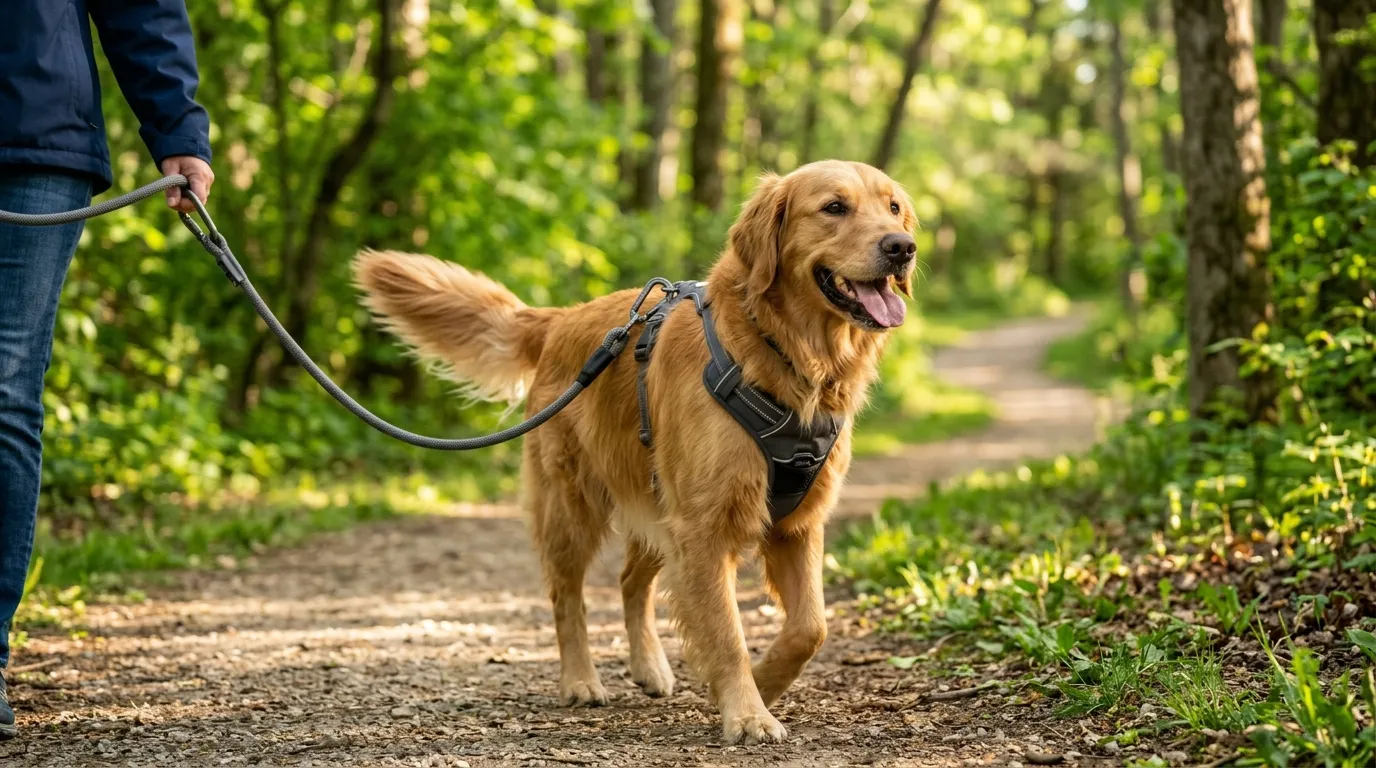
Short answer
The collar should always carry the ID tag, whether or not the leash clips there. For walking, a harness spreads the force across the chest and avoids direct pressure on the trachea, especially in dogs that pull or with respiratory issues. The safest combination is usually collar for ID and harness for the leash.
The question “collar or harness?” actually hides two separate questions: where does your dog’s ID live, and where does the leash clip on for walking. They don’t have to be the same point.
ID always goes on the collar
It doesn’t matter if you walk with a harness: the tag with your contact info should be on a collar worn at all times, not just during the walk. It’s the first thing anyone checks if they find your dog loose.
Adjustable neoprene-padded collar for dogs, XS-XL
What to look for: A nylon collar with neoprene padding where it touches the neck, a quick-release buckle, and a D-ring for the ID tag. A collar is meant to keep identification on at all times; it shouldn't be the leash's main attachment point on a dog that pulls.
-
 View on AliExpress Ships internationally · checked on 2026-09-02
 -
 View on Mercado Libre Available in Chile · checked on 2026-08-27
Why the harness wins for clipping the leash
When a dog pulls against a collar, all that force concentrates on the neck, an area with the trachea, esophagus, and important blood vessels underneath. A well-fitted harness spreads that same force across the chest and shoulders, areas with more muscle mass and no such sensitive structures below.
When a collar alone is enough
An adult dog that walks relaxed, with no abrupt lunges or reactivity to other dogs or stimuli, can walk with the leash clipped to the collar without much added risk. The collar itself isn’t the problem: it’s sustained or repeated tension against it.
What to check in a basic collar
- Padding where it touches the skin, not just flat webbing, to reduce chafing on thin-coated necks.
- A quick-release buckle, useful if the collar gets caught on something.
- A sturdy D-ring for the ID tag, resistant to tugging.
- A size chart in centimeters, matched to the actual neck circumference, not the breed’s nominal size.
The safest combination
For most dogs, the practical combination is: a collar worn at all times with ID, and a harness as the leash’s attachment point for daily walks. That covers both needs without forcing a single piece of gear to do everything.
Frequently asked questions
Can I use just a collar for walks if my dog doesn't pull?
Yes, that's reasonable for dogs that walk loosely beside you with no constant tension. The risk shows up with repeated hard pulling: that's where the pressure lands directly on the trachea.
Does the harness replace the collar?
Not for identification. The tag with your info should always be on the collar, worn at all times, even if the leash clips to the harness.
What if my dog has respiratory issues or a collapsible trachea?
A harness is the recommended option in those cases, since it avoids any pressure on the neck. Ask your veterinarian which model best suits the specific condition.
Does a padded collar prevent discomfort?
Padding reduces friction against fur and skin, but it doesn't change where the force lands if the dog pulls. It's still the neck, padded or not.