How to choose a cat carrier without it being a drama
Most carrier struggles are about the carrier, not the cat. Size, opening style, and how to get your cat used to it before you need it in a hurry.
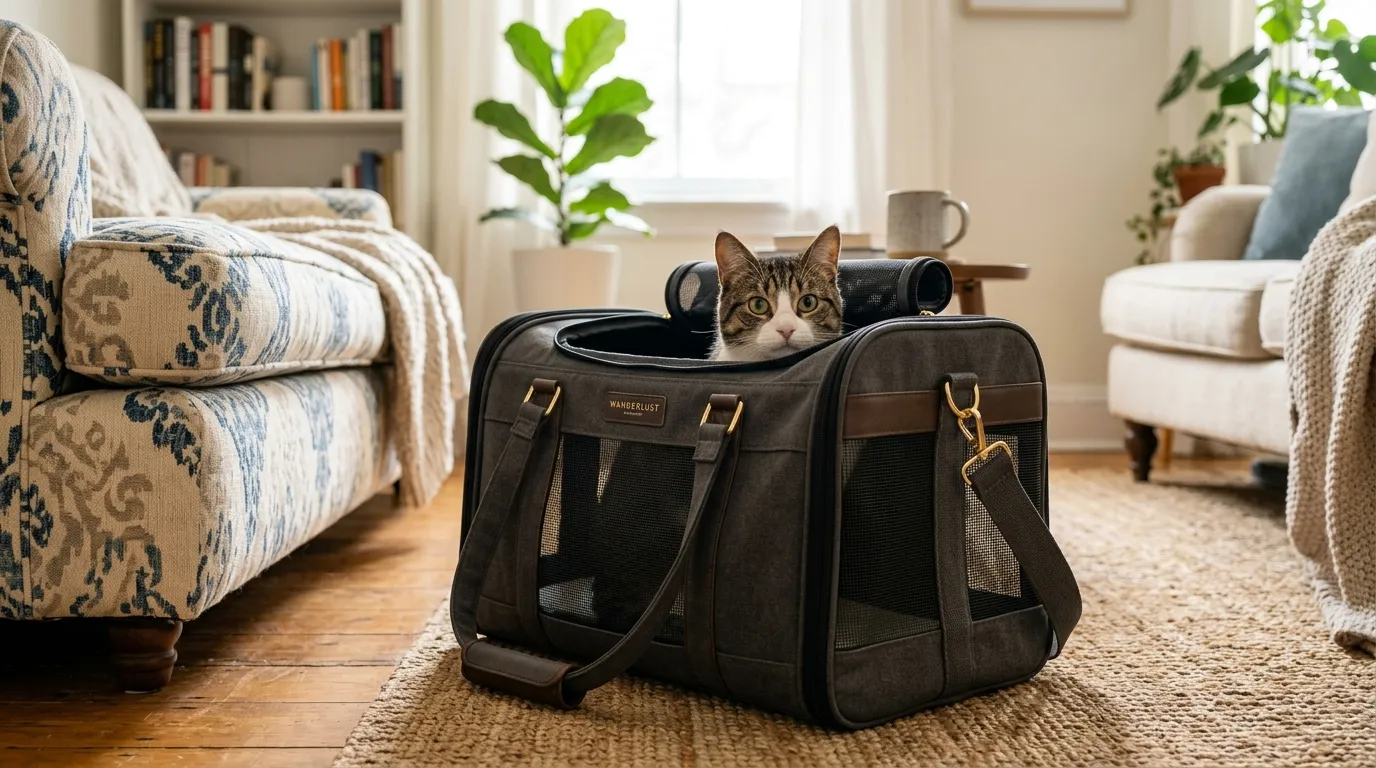
Short answer
A cat's resistance to the carrier is almost always explained by the carrier itself: it only shows up for vet trips, it's too small to turn around in, or it only has a narrow front opening that forces you to push the cat in. A carrier with a top opening, enough space, and a regular presence in the house solves most of the problem before it starts.
Almost every “my cat is impossible to transport” story has the same root: it isn’t that the cat is difficult, it’s that the carrier was poorly chosen, poorly placed, or only ever shows up at the worst possible moment.
Why the cat rejects it
Three reasons explain most cases:
- It only appears for vet visits. The cat associates the object with a stressful experience, not with the object itself.
- It’s too small. If it can’t turn around or stretch out inside, it feels like a trap, not shelter.
- The only opening is narrow and up front. That forces you to push the cat in from behind, the most stressful way to load it and the one most likely to end in scratches.
What to look for in a carrier
Soft-sided carrier bag, size M (43x28x28 cm)
What to look for: A semi-rigid structure that doesn't collapse when the animal moves inside, ventilated mesh on at least two sides, both top and side openings, and a padded strap. Measure before buying: 43x28x28 cm is the typical size for a cat or small dog, not for medium breeds.
-
 View on AliExpress Ships internationally · checked on 2026-08-27
 -
 View on Mercado Libre Available in Chile · checked on 2026-08-27
- A top opening, in addition to the front one. It lets you lower the cat in from above instead of pushing it in from behind, which cuts resistance dramatically in the moment.
- Real size, not the box size. The cat should be able to stand, turn around and lie stretched out inside. Measure your cat from chest to tail and compare against the interior dimensions, not the exterior ones.
- Ventilation on at least two sides. Side and front mesh keeps it from feeling boxed in and lets it see out if that helps it stay calm.
- A structure that doesn’t collapse. A poor-quality soft carrier sags when the cat moves inside, which increases the sense of instability. Look for internal reinforcement or a semi-rigid base.
- A padded strap and a firm closure. The closure is the only thing standing between the cat and an escape mid-trip; check it isn’t the weak point of the product.
Hard-sided or soft, depending on use
| If your situation is… | Works well | Better avoided |
|---|---|---|
| Long trips, flights, or frequent car transport | A hard-sided carrier, with a solid base | Relying on a soft bag alone for a flight: check the airline's requirements first |
| Short vet visits or a trip to a relative's house | A soft carrier with a top opening, light and easy to store | A large hard-sided carrier if storage space is tight |
| A cat with an already bad experience | Start the habituation process weeks before you need it | Bringing it out for the first time on the day of the trip |
How to get your cat used to it, before you need it
- Keep it out in the open, not stored away. Let it become part of the furniture, not an object that appears out of nowhere.
- Put a blanket or something that smells like your cat inside, and let it walk in and out on its own, without forcing it.
- Give treats near the carrier first, then inside it, in short, unhurried sessions.
- Practise closing it for a few seconds with the cat inside, while giving it something good, well before the day you actually need it.
In the car and in the waiting room
- Always secured or on the car floor, never loose on the seat: a hard brake can send it flying like any other object.
- Partly cover the carrier with a light blanket in the vet’s waiting room: it cuts down visual stimulation from other animals and often calms the cat.
- Don’t open it “to let it stretch” somewhere without closed doors. A frightened cat can escape in seconds and hide somewhere hard to reach.
When the resistance isn’t solved by the carrier alone
If your cat vocalises extremely, pants, drools excessively or urinates on itself during every trip despite habituation work, that goes beyond a one-off bad experience: it can be severe anxiety, and it’s worth discussing with your veterinarian, who may suggest behavioural management or, in specific cases, medication support for the trip itself.
Frequently asked questions
Why does my cat hide the moment it sees the carrier?
Because it learned to associate it only with the vet, which is often stressful in its own right. If the carrier lives stored away and only appears for that, the cat makes the connection instantly.
Hard-sided or soft?
Hard-sided for long trips or flights, because it protects better in an impact. Soft-sided for short, frequent trips, because it's lighter and easier to store. Many households end up with both.
What size do I need?
The cat should be able to stand, turn around and lie down comfortably inside. As a reference, measure your cat from chest to tail and add at least 10 to 15 cm extra in each dimension.
How do I get it in if it resists in the moment?
Never push it through a small front opening against its will: it raises stress and the risk of scratches for both of you. A carrier with a top opening lets you lower it in from above with much less resistance.