How to drive with your dog without it being a risk to anyone
An unrestrained dog in the car is a mass that goes flying in a hard brake. Restraint options, how to get your dog used to one, and what to avoid on the road.
Short answer
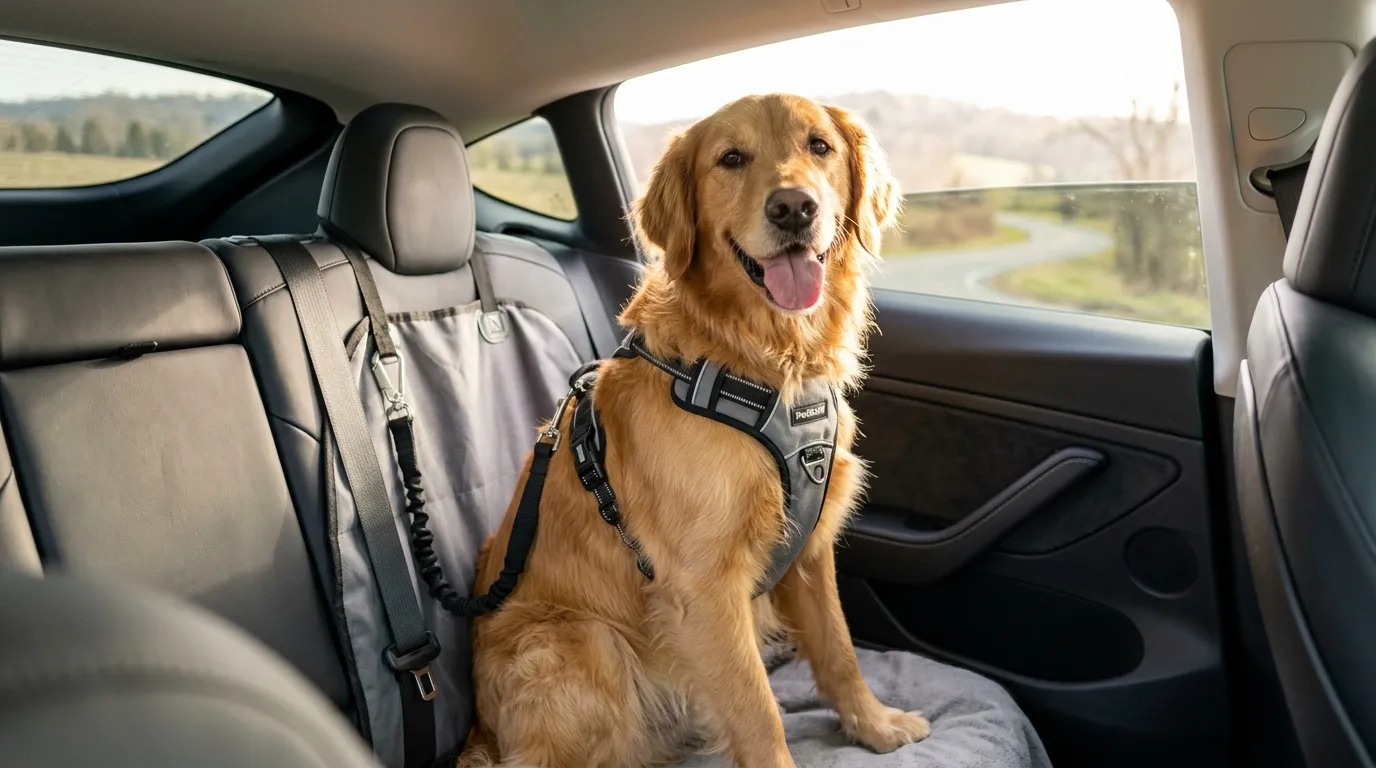
A 20 kg dog unrestrained during a hard brake at 50 km/h hits with a force equivalent to several times its own weight: a real risk to the dog, passengers and the driver. Restraint doesn't remove the risk entirely, but cuts it a lot, and the most practical option for most dogs is a belt that clips into the harness, not the collar.
Few habits this common are this unsafe: letting the dog ride loose in the car. It is not a minor quirk — it is a mass moving freely inside a vehicle, and physics doesn’t distinguish between a cushion and a four-legged passenger.
Why it matters more than it seems
In a hard brake at 50 km/h, a 20 kg dog can hit with a force equivalent to several times its own body weight. That puts three parties at risk at once:
- The dog itself, which can be thrown against the windshield or the front seats.
- The passengers, if the dog becomes a projectile inside the cabin.
- Whoever is driving, if the dog falls between the pedals or blocks visibility at the exact moment a quick reaction is needed most.
Restraint options, from most to least containment
How well protected the dog is with each option
| If your situation is… | Works well | Better avoided |
|---|---|---|
| Travel crate anchored to the vehicle | The option with the most containment; ideal for dogs already used to a crate | An unanchored crate: it becomes a projectile itself |
| Harness with a short belt clipped to the seat | A good balance of safety and practicality for most dogs | Clipping the belt to the collar instead of the harness |
| Boot barrier or divider grille | Useful combined with a fixed bed, for large dogs riding in the boot | Relying on the grille alone with no restraint at all |
| Loose on the seat | Avoid whenever any of the above is available | Holding the dog by hand from the front passenger seat while someone drives |
The car belt: what to look for
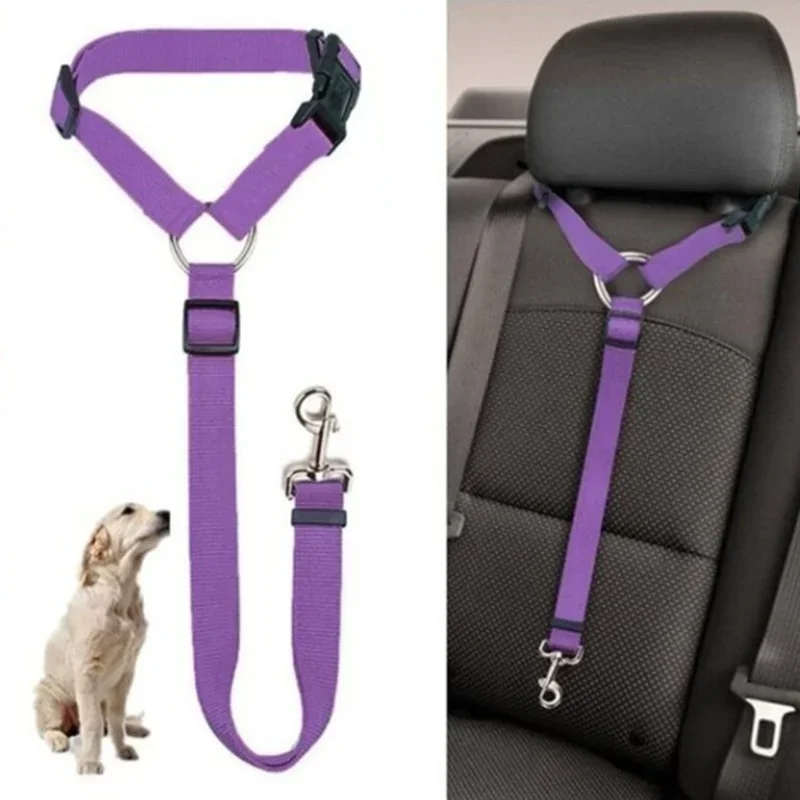
Two-in-one car seatbelt harness for dogs
What to look for: Works as a body harness and as a short leash that clips into the car's seatbelt buckle, with an adjustable length that limits how far the dog can move on the seat without pinning it in place completely.
-
 View on AliExpress Ships internationally · checked on 2026-08-26
 -
 View on Mercado Libre Available in Chile · checked on 2026-08-27
- Clips into the harness, never the collar. A hard brake concentrates all the force onto the anchor point; on the neck, that means real risk of tracheal injury.
- Short, adjustable length. It should let the dog sit or lie down, but never reach the front seats.
- Connects straight to the vehicle’s seatbelt buckle, not to an improvised hook on the headrest: that keeps the failure point to a single one, the same one already engineered to hold a human passenger.
- Reinforced stitching at the anchor point, which is where all the tension concentrates during a hard brake.
How to get your dog used to it
Most dogs do not accept restraint on day one. It helps to go step by step:
- Let it sniff and explore the harness and belt at home first, before putting it in the car.
- Use it on short, familiar trips, like driving to the corner, before a long journey.
- Pair the moment with something positive: a treat on getting in, not only on getting out.
- If the dog gets carsick or anxious in the car, solve that first with short, frequent trips before also asking it to accept restraint.
What to always avoid
- Never in the front passenger seat, restrained or not: the passenger airbag can cause serious injury to a dog if it deploys.
- Never with its head out the window at road speed: the risk of eye and ear injury is real, however picturesque the image.
- Never inside a parked car in the sun, not even with the windows cracked: the interior temperature climbs far faster than it seems, even on mild days.
When the trip itself isn’t the problem
If your dog drools excessively, vomits or shakes on every trip regardless of how much you’ve worked on getting it used to the car, it may be genuine motion sickness, a condition sometimes managed with veterinary medication. It is not a restraint or training problem, and it is worth discussing with a vet before continuing to expose the dog to trips it finds distressing.
Frequently asked questions
Can I let my dog ride loose in the back seat?
You can, but it isn't safe. Beyond the physical risk in a hard brake or crash, a loose dog can distract the driver, and in some places it is a traffic violation outright.
Does the belt clip into the collar or the harness?
Always the harness. Clipping into the collar concentrates the full force of a hard brake on the neck, with real risk of tracheal injury. The harness spreads that force across the chest and shoulders.
Is a car harness the same as a crash-tested one?
No. Most car harnesses sold in the mass market reduce movement but are not certified through independent crash testing. If you want maximum protection, specialist brands do carry that certification, at a considerably higher cost.
Is a travel crate safer than a harness?
A crate properly anchored to the vehicle usually offers more protection than a harness, because it fully contains the dog. The harness is the practical alternative when a crate isn't feasible because of space or the dog's size.