How to measure your dog for a harness that cannot slip off
The three measurements you need, how to take them properly, what to do when your dog falls between two sizes, and how to check the fit with the two-finger rule.
Short answer
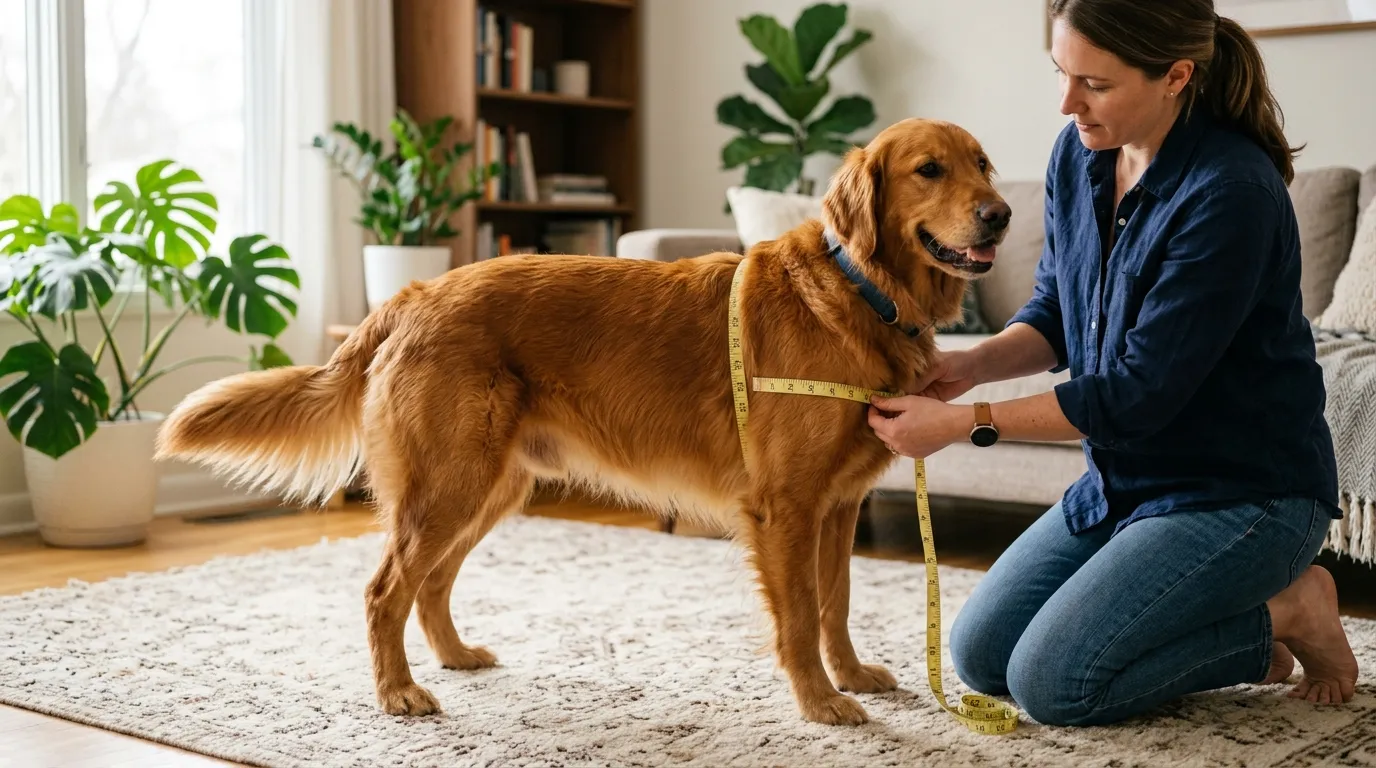
You need three measurements: neck girth, chest girth just behind the front legs, and back length. Always buy from the seller's size chart, never from the nominal size letter. If your dog falls between two sizes, size up only if the harness adjusts at both chest and neck; otherwise size down.
Most returned harnesses were not badly made: they were badly measured. And most dogs that “slip out of the harness” did nothing extraordinary — they simply backed up with their head low against webbing that had four fingers of slack.
This guide is useful even if you buy nothing. By the end you will have three numbers written down that you can check against any seller’s chart.
What you need
A piece of string and something to measure it with. If your dog fidgets, a second person. That is all.
The string method is the practical one and it costs nothing: wrap the string around the dog, mark with your fingers or a pencil where it closes, then stretch that string against a tape. Just as accurate as a sewing tape, and far easier to handle with a dog that will not stay still.
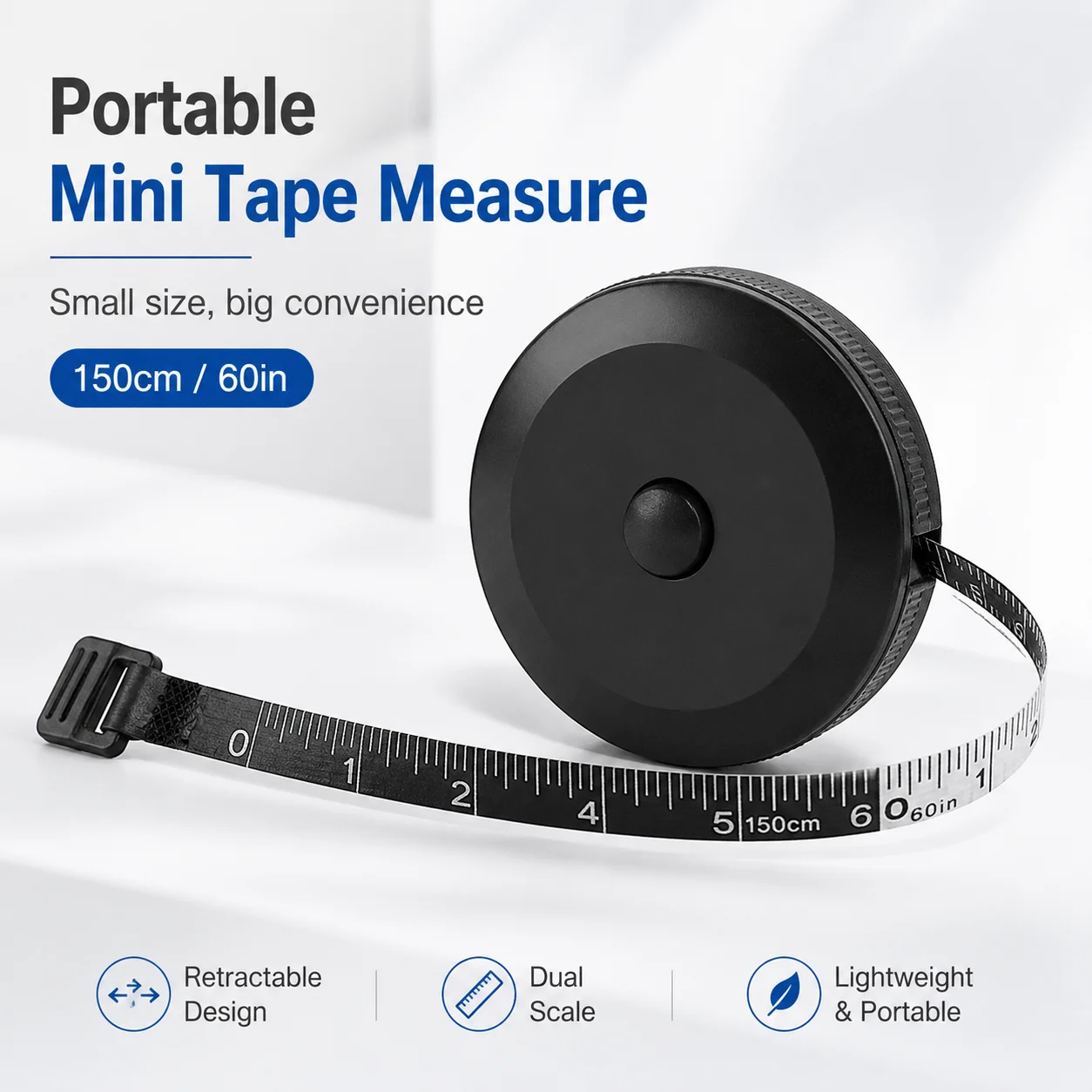
If you already own a flexible tape, better still: measure straight on the dog and skip the string step. Do not go out and buy one just for this. If you are placing an order anyway, this is the kind that works, and it costs about what a coffee does:
150 cm retractable tape measure with dual scale
What to look for: A 1.5 m flexible blade with centimetres on one face and inches on the other, and a button to retract it. Being flexible, it goes straight onto the dog: no string method needed.
-
 View on AliExpress Ships internationally · checked on 2026-08-26
 -
 View on Mercado Libre Available in Chile · checked on 2026-08-27
What does not work is a rigid builder’s tape: it will not bend around the ribcage and you end up with a number you invented.
The three measurements
1. Chest girth (the one that decides)
Wrap the tape around the chest just behind the front legs, at the widest part of the ribcage. This is the dog’s bulkiest point and the measurement that determines size on virtually every chart.
Common mistakes:
- Measuring too far back, over the belly. It gives a smaller number and the harness arrives tight across the chest.
- Pulling the tape tight. It should lie flat against the coat without sinking into it.
- Measuring while the dog is sitting. Always standing, on all four feet.
2. Neck girth
Wrap around the base of the neck, where a collar would sit, not high up near the head. On Y-shaped harnesses this measurement determines the chest opening.
3. Back length
From the base of the neck to the base of the tail. It rarely determines size on walking harnesses, but it does on car harnesses and vests, and it helps you rule out models that would cover the base of the tail.
How to read the seller’s chart
Look for the chart in the listing itself, not in the brand’s generic description. If the listing has no chart with measurements in centimetres, buy elsewhere: you have no way to verify, and you will pay for the return in time.
When you find the chart, check that your chest girth falls inside the range, not at its edge. A dog with 58 cm of chest in a 45 to 60 cm range is at the limit: any change in coat pushes it out.
What to do if your dog is between two sizes
Between two sizes: what works
| If your situation is… | Works well | Better avoided |
|---|---|---|
| The model adjusts at neck and chest (two or more buckles) | Take the larger size and tighten inwards | Taking the smaller one expecting it to give: webbing does not give |
| The model has a single adjustment buckle | Take the smaller size if the range allows it | The larger size: it leaves fixed slack that allows backing out |
| A growing puppy | Current size with room to adjust, re-measured every 3 to 4 weeks | Buying the adult size so it lasts |
| Long or double-coated dog | Measure in the heaviest coat season and use that number | Measuring straight after a groom |
The product and its criteria
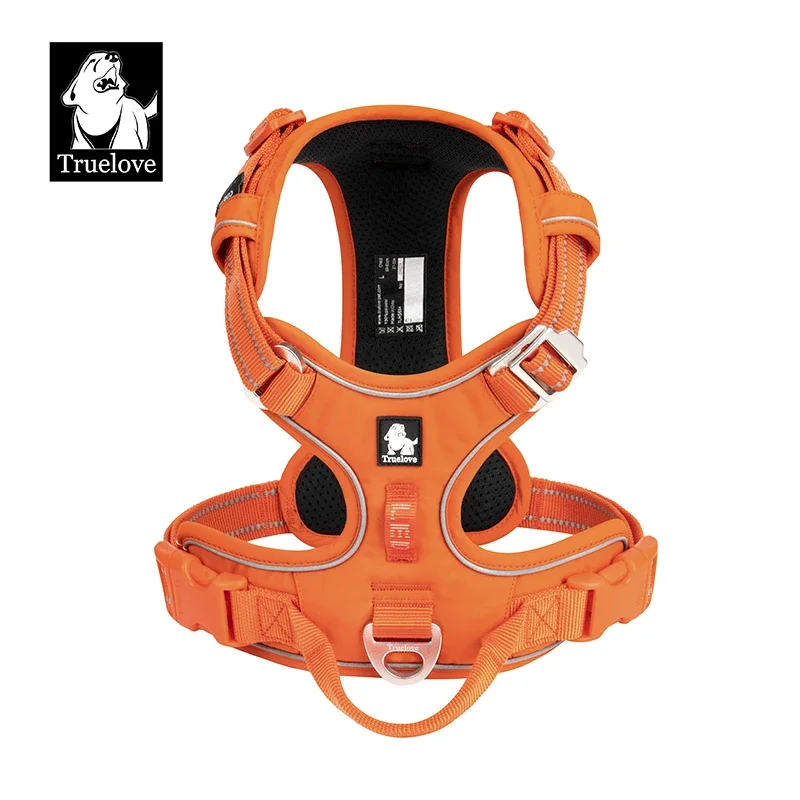
Truelove TLH5654 reflective nylon step-in harness
What to look for: Adjustable at chest and neck, wide padded webbing, back attachment point, reflective strips and an XS-to-XL size chart in centimetres. Check your three measurements against that chart before buying.
-
 View on AliExpress Ships internationally · checked on 2026-08-26
 -
 View on Mercado Libre Available in Chile · checked on 2026-08-27
Two things to be clear about first. This is not a Y-shaped harness. It is a step-in model: the dog steps into it and you close it over the back. The Y-shaped harness, the one that leaves the shoulder joint free, is a different category and costs considerably more; if your dog has an orthopaedic diagnosis that difference matters, and the decision stops being a purchase and becomes a consultation.
Second: buying from an international marketplace means shipping takes weeks, and so does a return. That does not change what to look for, but it raises the cost of getting it wrong. Measuring properly stops being a recommendation and becomes the only thing protecting you, because you will not be swapping sizes that weekend.
This is what separates a decent harness from a bad one:
- Adjustment at two points, chest and neck. That is what lets you correct when your dog falls between sizes, and what prevents backing out of it.
- Wide padded webbing at the load-bearing points. Thin webbing concentrates pressure onto a narrow strip of skin.
- A size chart in centimetres in the listing. Without it you have nothing to check your three measurements against. The model above carries one, XS to XL, and its reviews include buyers publishing their dog’s real figures: a 48 cm neck and 67 cm chest in a size M, three corgis with 60 cm chests in another. That kind of data is worth more than the size letter.
- A solid back attachment point, plus a chest one for training if the model offers it.
- Reflective strips, which matter more than you would think on night walks.
And an honest limit: we did not test this model. What we did verify, and you can check yourself, is that it is sold by the brand’s own official store, that the listing carries the size chart in centimetres, and that its ratings belong to that listing rather than being an average across similar products, which is common in these catalogues. The rest — your numbers falling inside the range and not at its edge — you decide with the chart in front of you.
How to check the fit on day one
The two-finger rule: you should be able to slide two flat fingers between the webbing and the dog’s body, at both neck and chest. No more, no less.
Then run this test indoors, never on the street:
- Put the harness on and clip the lead.
- Let the dog walk a few metres, then step backwards yourself, creating gentle backward tension.
- Watch whether the chest strap rides up towards the neck. If it does, it is loose.
Signs to stop
- Rub marks, worn fur or reddened skin at the armpits or chest after a walk.
- The dog changes its gait or shortens its front stride with the harness on.
- Any limp that appears after you start using it.
In those cases take the harness off and get advice before using it again.
Frequently asked questions
My dog is between size M and L. Which one?
It depends on how many adjustment points the model has. With adjustment at both neck and chest, the larger size works. With a single buckle, the larger size almost always leaves enough slack for the dog to back out of it.
Can I use the collar measurement to pick a harness?
No. The measurement that determines harness size is chest girth, not neck. A dog with a slim neck can have a broad chest, and the other way round.
How often should I re-measure?
Puppies, every 3 to 4 weeks while they grow. Adults, whenever weight changes or the coat season turns. A harness that fitted in winter can be loose once the dog sheds.
Will a harness stop my dog pulling?
Not on its own. A harness spreads the force and keeps pressure off the trachea, which is a real safety benefit. Stopping the pulling is a training matter, not a product one.