How to walk your cat on a harness, step by step
A cat needs to get used to the harness indoors before even thinking about going outside. How to make the transition without triggering rejection, and what to expect from the first walk.
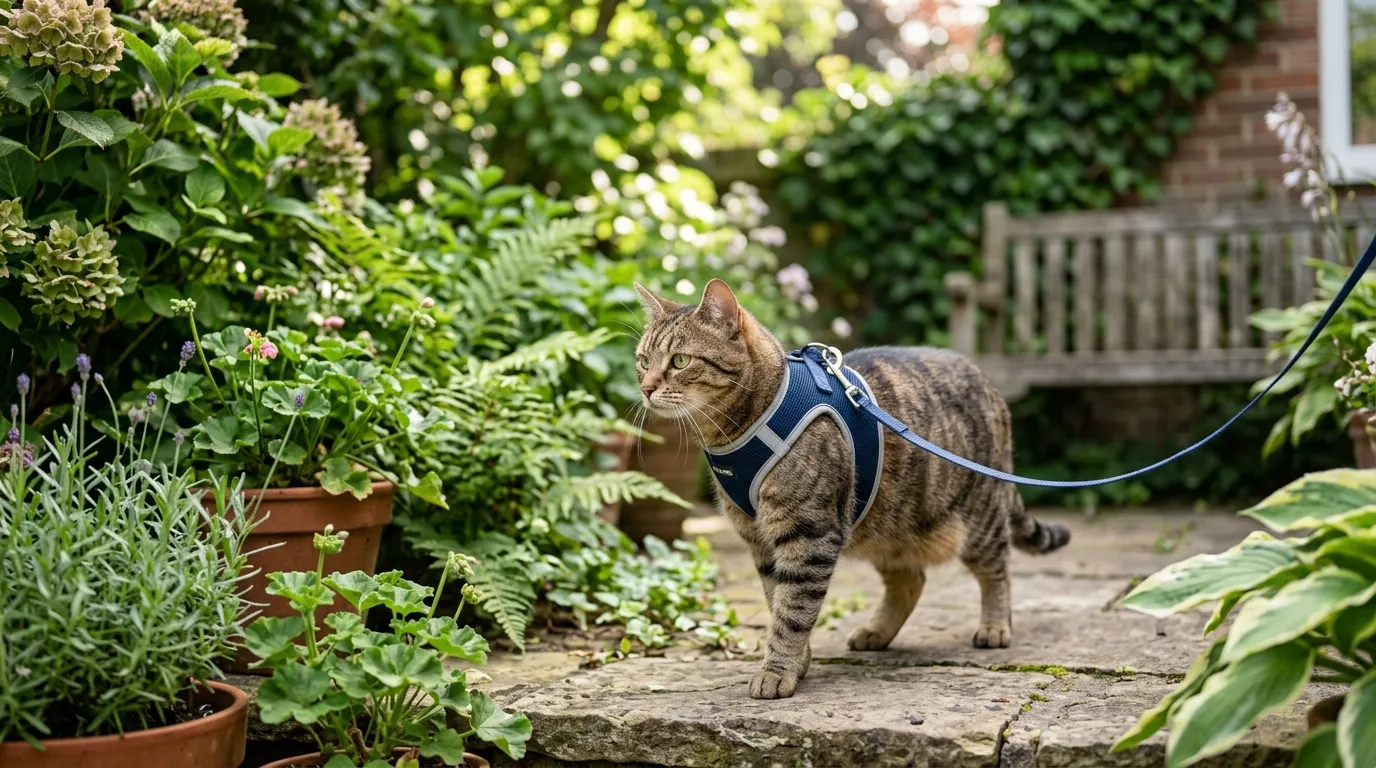
Short answer
Walking a cat on a harness is possible, but it requires a gradual acclimation process indoors before the first real walk. A cat that never accepted the harness in its own familiar territory won't tolerate it better outside, surrounded by new stimuli and without the safety of a familiar space.
Unlike a dog, a cat isn’t born inclined to walk alongside a person with something strapped to its body. A harness can work, but the process beforehand, indoors, matters as much as the walk itself.
The acclimation process, don’t skip it
Adjustable harness and leash set for cats and small dogs
What to look for: A padded harness with dual adjustment (chest and neck) and an included reflective leash, for supervised walks with cats gradually acclimated to it. It should never be used to restrain a cat that hasn't yet accepted the harness indoors; acclimation comes before the walk.
-
 View on AliExpress Ships internationally · checked on 2026-09-02
 -
 View on Mercado Libre Available in Chile · checked on 2026-08-27
Stages of harness acclimation
| If your situation is… | Works well | Better avoided |
|---|---|---|
| First few days | Leave the harness near its food or bed, without putting it on | Putting it on right away without letting the cat sniff it first |
| Once it ignores the harness without fear | Put it on loosely for a few minutes, with treats, indoors | Leaving it on snug for the first time for many hours |
| Once it walks normally at home with the harness on | Clip the leash and let it drag it around indoors | Going outside before this stage |
| First real walk | A calm, familiar space, a short session | A new place with noise, traffic, or other animals |
Why you can’t skip stages
A cat that never accepted the harness indoors, in its own familiar territory, won’t tolerate it better outside, surrounded by new stimuli and without the safety of a familiar space. Rejection amplifies with the change of environment; it doesn’t resolve on its own.
What to check in the harness before starting
- Dual adjustment, chest and neck, so it can’t slip off if the cat twists.
- Padding where it touches the skin, with no seams that chafe.
- A reflective leash, useful for low-light outings.
- A size matched to the actual measurements, not the generic “adult cat” reference.
The first real walk
Choose a calm, familiar space for the first real attempt, short sessions of a few minutes, and let the cat set the pace. Forcing the walk before it’s ready usually delays the process instead of speeding it up.
Frequently asked questions
Can any cat learn to walk on a harness?
Not all of them. Some cats never feel comfortable wearing a harness, no matter how much gradual acclimation is attempted. Respect that signal if strong rejection continues after several weeks.
At what age should I start?
The earlier the better, ideally during the kitten stage, though adult cats can also learn with patience and a slower process.
Can I use the harness straight outside if my cat already goes out without a leash?
It's not the same. A cat that roams freely in a familiar yard hasn't had the same training as accepting restricted movement with a harness on. Go through the transition anyway, even if it already goes out on its own.
What do I do if my cat flops on the floor and won't walk?
It's a common early reaction. Don't drag it: wait, offer treats nearby, and let it decide to move on its own. Forcing it creates more rejection, not less.