Vertical space for cats in small apartments
A cat needs height, not square meters. How to use wall shelves to gain vertical space without giving up floor room, and what to check before anchoring anything to a wall.
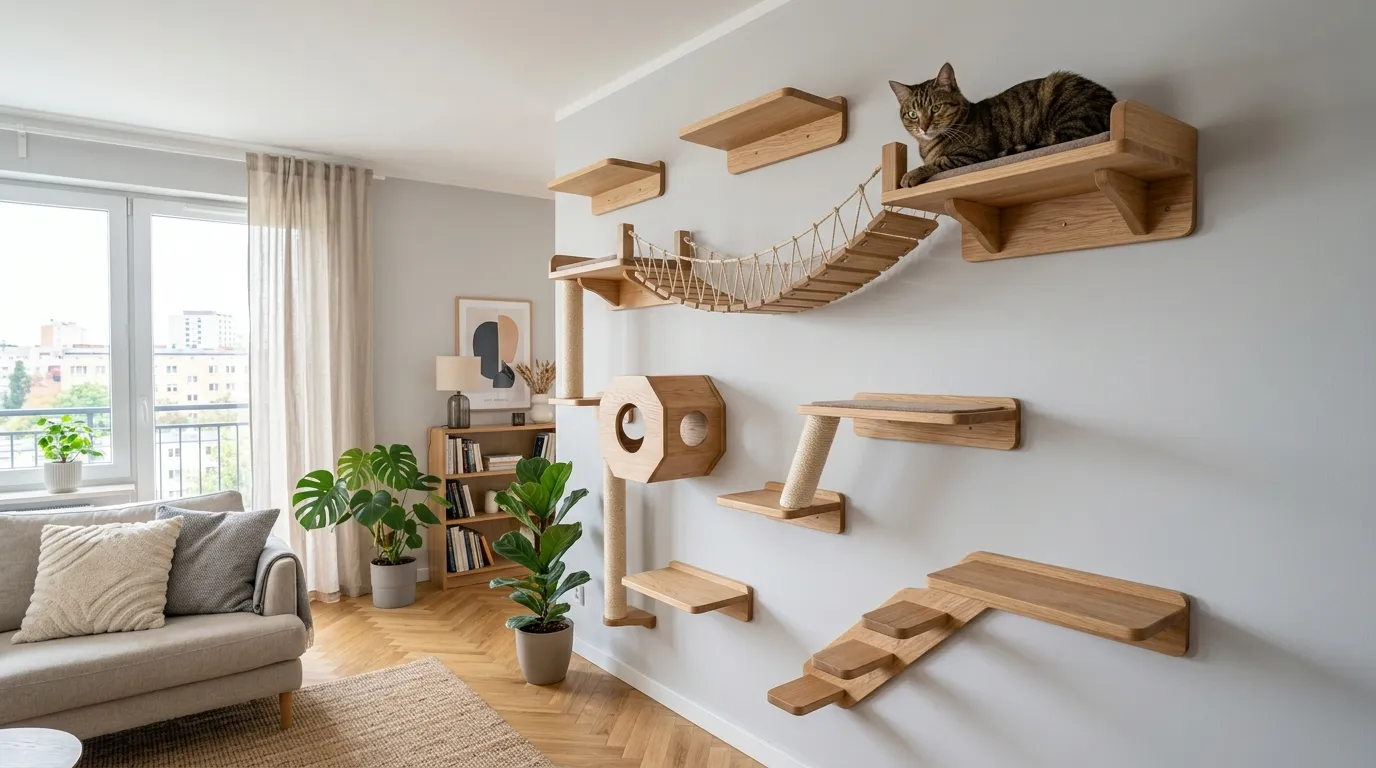
Short answer
Cats are vertical-territory animals: they watch and feel safe from above, not necessarily from wide open floor space. In small apartments, well-anchored wall shelves give the height a floor scratcher can't offer without eating up square meters you don't have to spare. The wall anchoring, not the design, is what decides whether they're actually safe.
A small apartment isn’t necessarily a bad place for a cat. What’s usually missing isn’t floor space: it’s usable height. A cat that watches its territory from above feels safer than one confined to floor level, no matter how many square meters that floor has.
Why height matters more than square footage
In the wild, a cat up high has the advantage: it sees before being seen, and can assess a situation before deciding to come down. That behavior doesn’t disappear in an apartment. A cat with no access to high points tends to show more signs of stress around visitors, noise, or other animals, simply because it has nowhere safe to retreat and observe from.
Wall shelves solve this without touching the floor, which in a small apartment is usually already taken up by furniture.
Curved wall shelves for cats with hammock and steps
What to look for: A set of wall platforms with a hammock and intermediate steps, designed for apartments with no floor space to spare. The wall anchoring is what makes it safe: check that it includes screws and anchors suited to your wall type, not just tape or velcro.
-
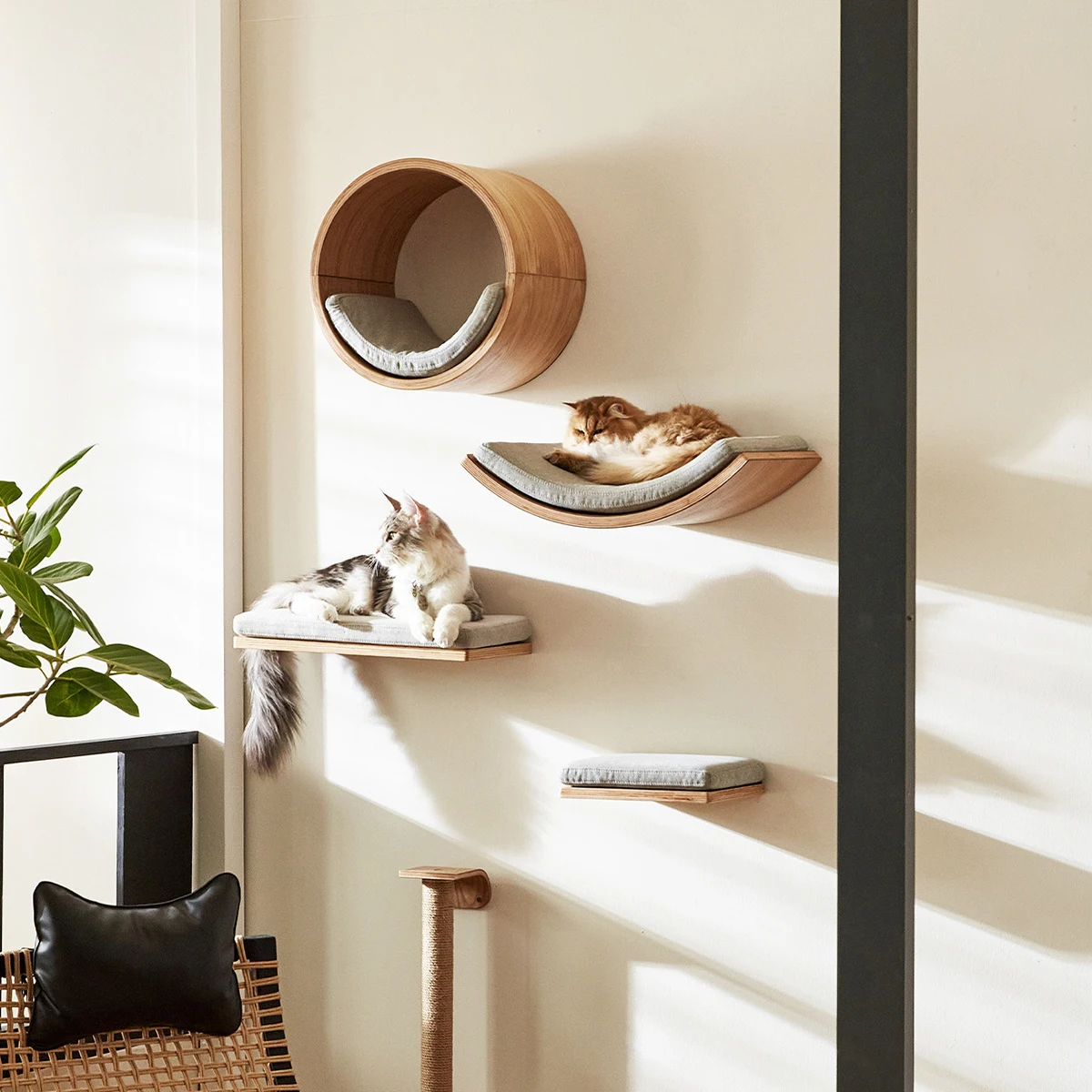 View on AliExpress Ships internationally · checked on 2026-08-30
 -
 View on Mercado Libre Available in Chile · checked on 2026-08-27
The one thing that actually matters: the anchoring
The shelf’s design, look, or hammock fabric don’t matter at all if the wall anchoring fails. A shelf that comes loose with the cat on it is a fall accident, not an aesthetic choice that went slightly wrong.
Planning the route, not just the shelves
Reasonable distances between platforms
| If your situation is… | Works well | Better avoided |
|---|---|---|
| First shelf from the floor | 40 to 60 cm, a comfortable jump with no effort | Starting too high: the cat simply won't use it |
| Between one shelf and the next | A distance the cat can jump without a running start | Jumps that require a run-up in a narrow hallway |
| The final, highest shelf | Near a window or a good observation point | A high shelf with no view or purpose at all |
| An older cat or one with arthritis | A route with more intermediate steps, less total height | Long jumps between widely spaced levels |
What to check before buying a set
- Included hardware suited to your wall, or a budget for buying specific anchors separately.
- Declared maximum weight per platform, with margin above your cat’s actual weight.
- A non-slip surface, not just a decorative one: a smooth platform gets slippery with use.
- The ability to reinforce the anchoring yourself, without relying solely on the factory installation.
An honest limit: no generic shelf set comes independently load-tested for the dynamic weight of a jump. Real safety depends on you checking the anchoring yourself, on your specific wall, not just following the instructions in the box.
Frequently asked questions
Does it work on any type of wall?
Not necessarily. Solid masonry walls accept standard anchors; drywall partitions need special weight-rated anchors, and it's worth looking for a wooden stud behind it if possible.
How many shelves does a cat need?
There's no fixed number, but more than one level connected by steps or jumpable gaps gives more route options than a single isolated shelf, which tends to get used less.
Does it replace a scratcher?
No. A shelf gives height and resting space, not necessarily a surface meant for scratching. If your cat also needs to scratch, add a separate sisal post.
What height is reasonable for the first shelf?
Low enough for the cat to jump up effortlessly, generally between 40 and 60 cm off the floor, then work upward toward higher shelves.