Why you should elevate your cat's food bowl
Eating from a low bowl presses the whiskers against its walls, which some cats avoid by eating only around the rim. How an elevated feeder changes that, and what to check before buying one.
Short answer
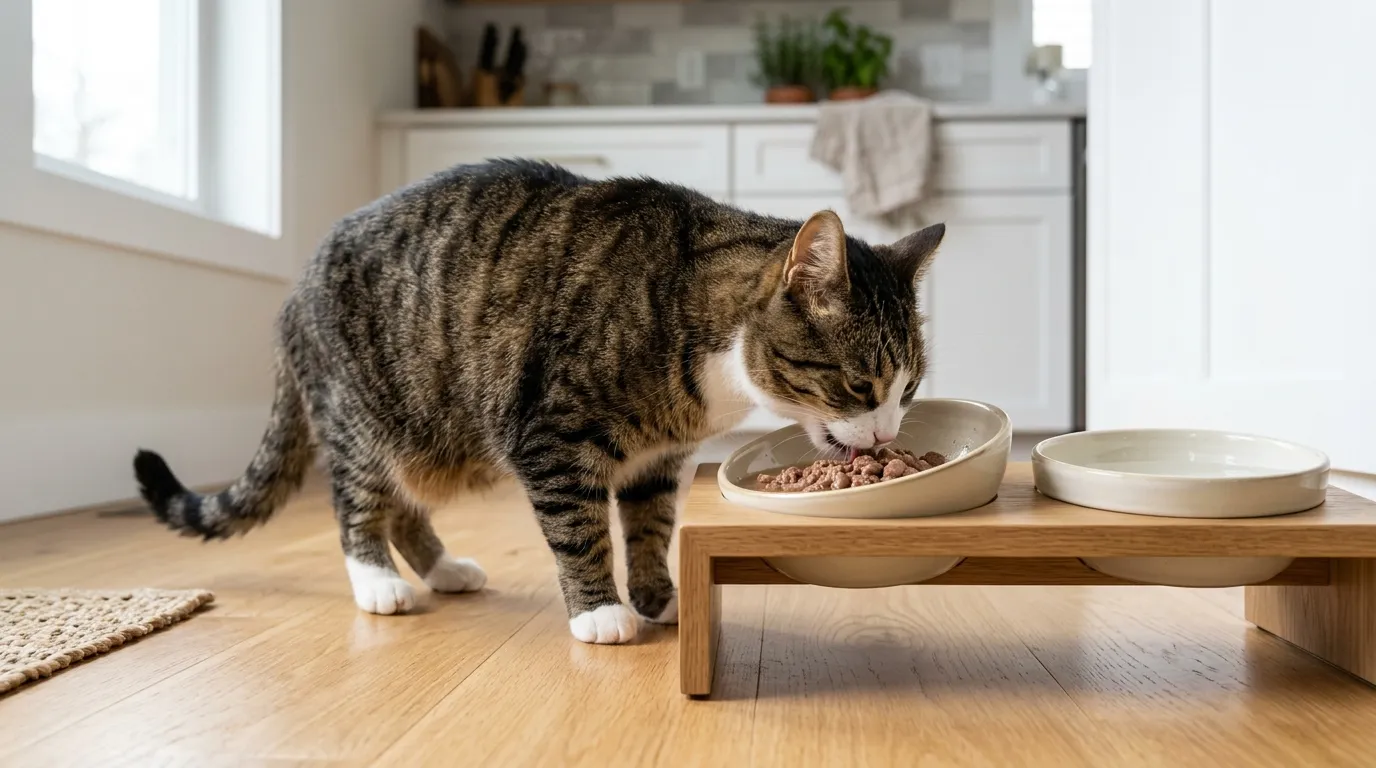
A low, narrow bowl forces a cat's whiskers to brush against the plate's walls with every bite, which some cats find uncomfortable enough to start scooping food out with a paw instead of eating straight from it. An elevated, tilted feeder reduces that pressure and also improves neck posture while eating, especially for older cats.
A cat that scoops food out of the bowl with a paw to eat it off the floor isn’t necessarily being fussy: it may be avoiding having its whiskers brush the bowl’s walls with every bite. It’s a real behavior, though not every cat shows it, or with the same intensity.
What whisker fatigue is
Whiskers are heavily innervated sensory organs, not simple decorative hair. A narrow, high-walled bowl forces them to compress against the edges with every bite, which in some cats causes uncomfortable overstimulation informally known as “whisker fatigue.” It isn’t described as a formal clinical diagnosis, but the avoidance behavior (scooping food out, eating only around the rim) is commonly observed.
3-in-1 elevated feeder set with water dispenser for cats
What to look for: A tilted base that raises the food and water bowls to the cat's neck height, with a gravity-fed water bottle included. The tilt reduces pressure on the whiskers and neck while eating; check that the bowls come out separately for washing.
-
 View on AliExpress Ships internationally · checked on 2026-08-30
 -
 View on Mercado Libre Available in Chile · checked on 2026-08-27
Why height matters too
Beyond the bowl’s width, a feeder’s height changes neck posture while eating. A very low bowl forces an older cat or one with cervical arthritis to flex its neck more than comfortable at every meal, several times a day. Raising and slightly tilting the plate brings the food closer to a more neutral posture.
What to check before buying an elevated feeder
- Removable bowls, so they can be washed separately from the base.
- A wide, stable base, that doesn’t slide or tip over when the cat pushes the plate while eating.
- The tilt angle, not just the height: a raised but perfectly horizontal plate doesn’t change neck posture much.
- Easy-to-clean materials, because wet food residue in crevices builds up bacteria quickly.
An honest limit
Elevating the feeder doesn’t fix an underlying dental, digestive, or feeding behavior problem. If your cat stops eating, eats much more slowly than usual, or shows pain while chewing, an elevated feeder doesn’t replace a vet check-up.
Frequently asked questions
Do all cats need an elevated feeder?
Not all of them need it, but it especially helps cats sensitive to whisker fatigue, older cats with neck stiffness, and brachycephalic cats with short muzzles.
How do I know if my cat has whisker fatigue?
If it scoops food out of the bowl with a paw to eat it off the floor, or only eats around the rim leaving food in the center, that can be a sign, though it can also have other causes.
Is the ideal height the same for every cat?
No. It depends on the cat's size; the right height is one that lets it eat with its neck relatively straight, neither too hunched nor stretched too far up.
Does it also help with water?
Yes, the same principle applies to water: an elevated dispenser or bowl reduces pressure on the whiskers while drinking, just like while eating.