Why your cat isn't drinking enough water, and what to do about it
Cats evolved to get most of their hydration from prey, not from a bowl. Signs of low intake, why still water puts them off, and how to pick a fountain they will actually use.
Short answer
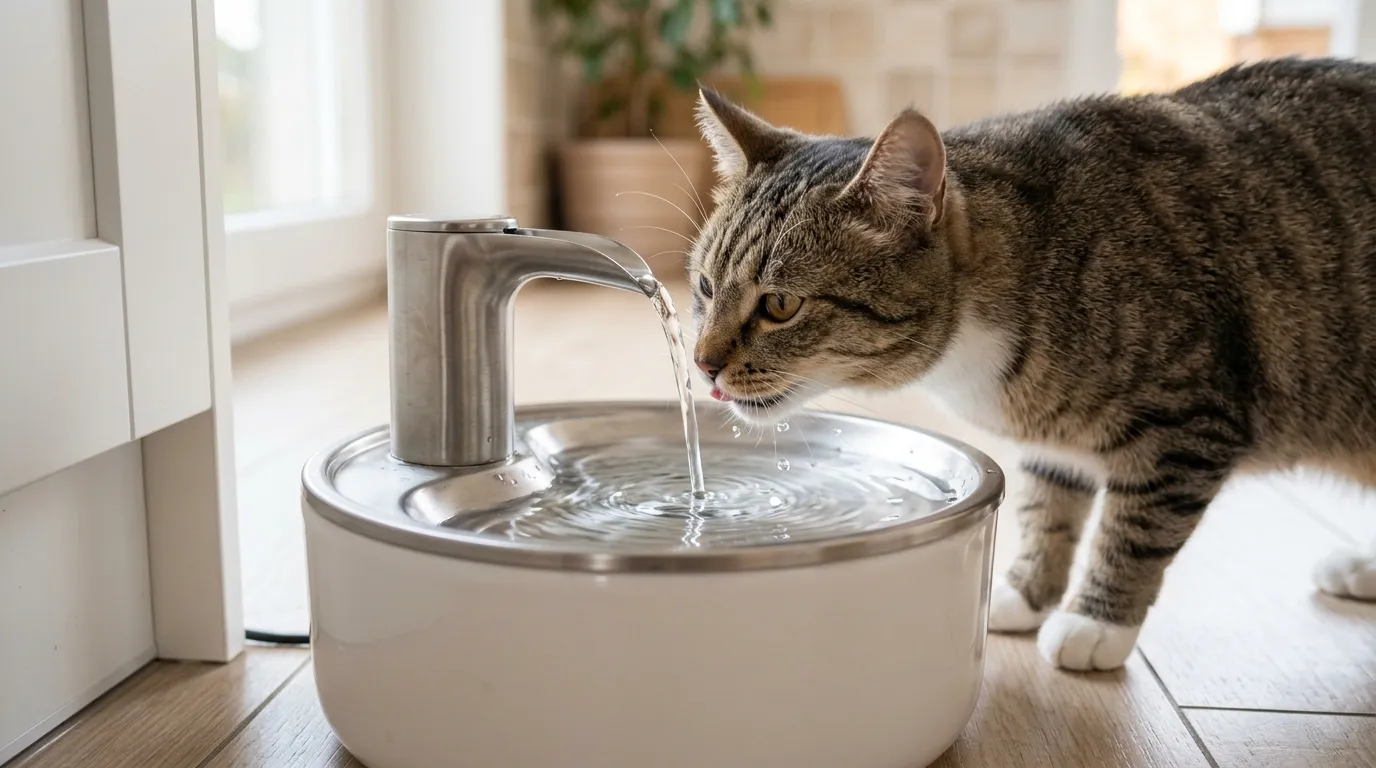
In the wild, cats get most of their water from prey rather than from drinking directly, which left them with little biological urgency to seek out water on their own. On a dry-food-only diet, low water intake shows up less in the bowl and more in the litter tray: concentrated, infrequent urine. A fountain with moving water does not fix every case, but in many cats it measurably increases intake.
The domestic cat descends from a desert animal that hunted small prey around 70% water by body weight. That evolutionary history left it with a fairly insensitive thirst mechanism: in the wild it barely needed to drink water directly, because it got it from eating. The problem is that an indoor cat eating dry kibble does not get that supply, and instinct does not compensate with a stronger urge to visit the bowl.
How to tell if your cat isn’t drinking enough
It is not always obvious from looking at the water bowl. Watch instead for:
- Strong-smelling, very concentrated urine in the litter tray.
- Small, infrequent clumps, instead of several a day.
- Skin that is slow to spring back when gently pinched between the shoulder blades (a rough indicator, not a diagnosis).
- A marked preference for drinking from unusual sources: the tap, a glass, a vase, a puddle in the shower.
Why still water doesn’t convince them
Three behaviours documented in cats:
- Moving water reads as fresher and less likely to be contaminated, a trace of wild instinct.
- Whiskers brush against the sides of a narrow bowl, which many cats find unpleasant (whisker fatigue). They prefer wide, open surfaces.
- Location matters as much as the container. A bowl placed next to food or near the litter tray reads as contaminated by the smell of both, and many cats simply avoid it.
What a water fountain actually does
A pump recirculates water from a reservoir through a filter and lets it trickle or bubble continuously. It is not magic: it solves two of the three reasons above at once, by moving the water and physically separating it from food by placing it somewhere else in the house.
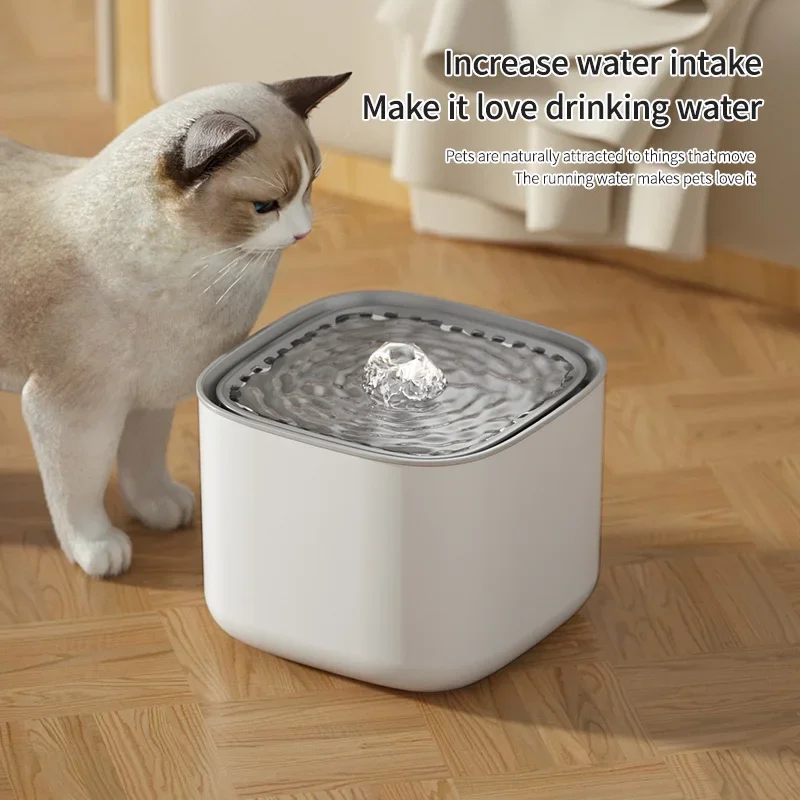
3 L cat water fountain with filter and USB pump
What to look for: At least 2 litres of capacity so it does not need daily refilling, a replacement filter sold separately, a quiet USB-powered pump, and a visible reservoir so you can check the level without taking it apart.
-
 View on AliExpress Ships internationally · checked on 2026-08-26
 -
 View on Mercado Libre Available in Chile · checked on 2026-08-27
How to pick one your cat will actually use
What to prioritise depending on your situation
| If your situation is… | Works well | Better avoided |
|---|---|---|
| A single cat in a small flat | 1.5 to 2 L fountain, placed away from food and the litter tray | Giant fountains built for several cats: extra size with no extra benefit |
| Several cats at home | A fountain of at least 2 to 3 L, or two bowls in different spots | One small shared fountain: a timid cat may end up with no real access |
| An older cat or one with joint issues | A wide, low reservoir, easy to reach without stretching the neck | Tall fountains or deep rims that force an awkward posture |
| Tight budget, or testing whether the cat will use one | Start by leaving a tap running a few minutes a day to gauge the reaction | Buying the most expensive fountain without confirming still water is really the issue |
Beyond the table, three technical points worth checking before buying:
- A replacement filter sold separately. Without periodic changes (every 2 to 4 weeks), the filter clogs and a fountain that has stopped filtering is worse than not having one at all.
- A quiet pump. A jumpy cat can avoid a noisy fountain entirely, especially in the first few days.
- Easy to take apart for washing. A fountain that is a chore to clean ends up unmaintained, and stagnant water with biofilm is worse than a simple bowl kept properly clean.
How to make the switch
Most cats do not change habits on day one. It helps to:
- Keep the old bowl available for the first two weeks, alongside the new fountain.
- Place the fountain somewhere the cat walks past often, not tucked away.
- If it eats dry kibble, add a little water to the food as a backup while it adjusts, after checking with your vet if it has any medical condition.
When the fountain isn’t the problem
If your cat drinks normal amounts but strains, bleeds, or urinates outside the litter tray, that is not solved with hydration: it is a reason for urgent veterinary attention, especially in male cats, where a urinary blockage is a real emergency.
Frequently asked questions
How much water should my cat drink a day?
As a rough guide, about 50 ml per kilo of body weight a day, counting the water that comes with wet food if the cat eats it. A 4 kg cat fed only dry kibble needs to drink considerably more directly than one eating wet food.
Why does my cat prefer the tap or a glass of my water?
Moving water reads as fresher and less likely to be contaminated, a trait inherited from wild ancestors. It can also be that the bowl sits too close to the food or litter tray, which many cats avoid.
Does wet food replace the need for a fountain?
It reduces it a lot, not eliminates it. Wet food carries a fair amount of water, but a cat eating only dry kibble depends almost entirely on what it drinks directly.
How many fountains or bowls do I need with several cats?
The same logic as the litter box: at least one per cat, in different locations, away from food. A timid cat may avoid a fountain that another cat controls.