Why your cat needs wand toy play (and not just a laser)
A laser pointer gives nothing to actually bite at the end, and that can frustrate a cat. How wand play completes the hunting sequence, and why it's worth rotating with other stimuli.
Short answer
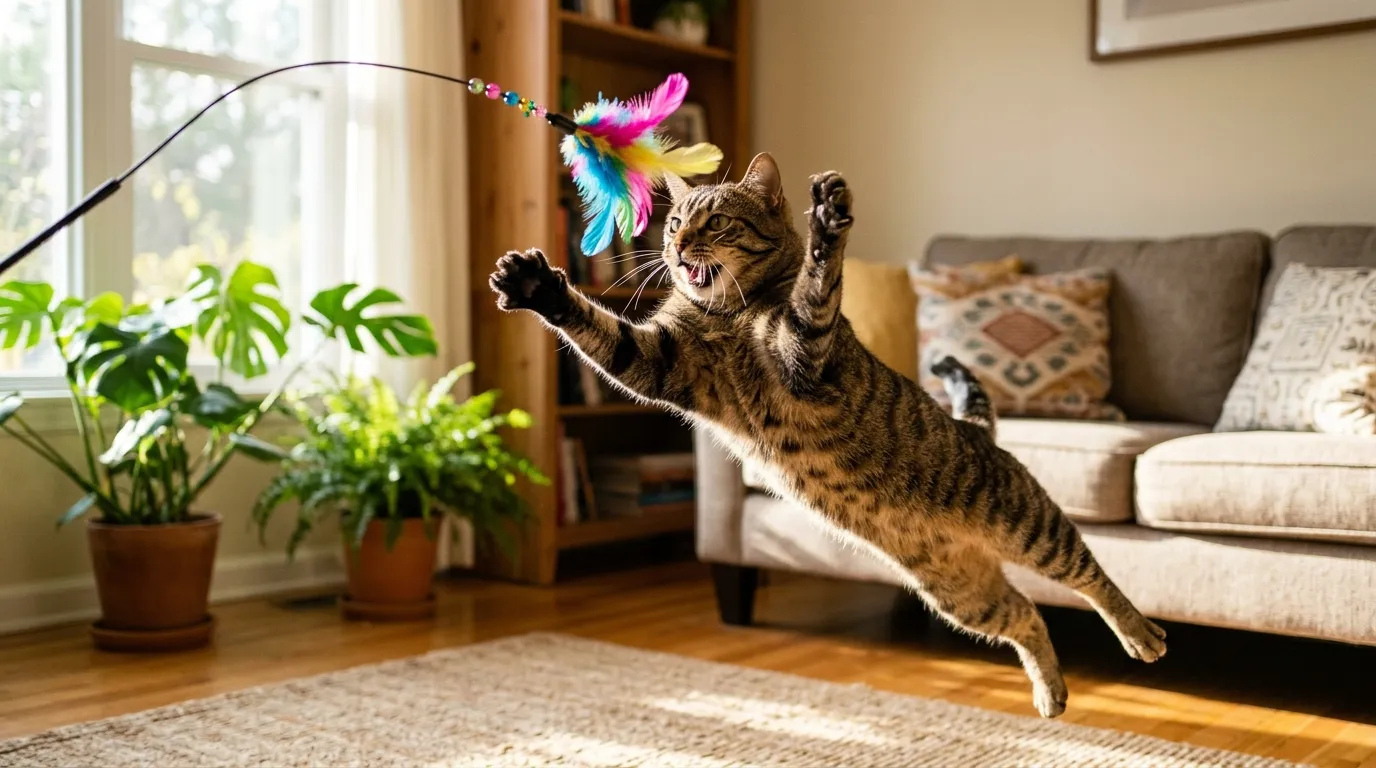
A cat hunts in a full sequence: stalk, chase, catch, bite. A laser pointer cuts that sequence right before the end, because there's nothing physical to catch, which can build up as frustration. A wand toy with a fabric pendant lets the cat complete the whole sequence, including the biting part, which is what actually closes the cycle and settles the cat.
A cat that chases a laser for 20 minutes and never “catches” it isn’t just playing: it’s repeating a sequence that never closes. Over time, that can build up as frustration instead of satisfying exercise.
The complete hunting sequence
Feline hunting behavior has a structure: stalk, chase, catch, bite. Every step matters, and the final one (biting something real) is what produces the release of tension that leaves a cat calm after playing. A toy the cat can never physically catch leaves that sequence incomplete, over and over.
Steel spinning wand with bell and fish pendant for cats
What to look for: A flexible wand on a suction-cup base, with a bell and a fabric pendant that mimics prey. Wand play simulates the full hunting sequence (stalk, chase, catch), unlike laser play, which leaves nothing to actually bite at the end.
-
 View on AliExpress Ships internationally · checked on 2026-08-30
 -
 View on Mercado Libre Available in Chile · checked on 2026-08-27
How to play in a way that mimics real prey
- Move erratically, not in a constant straight line. Real prey doesn’t run in perfect circles.
- Let the pendant hide behind furniture or a chair leg, so the cat has to stalk before attacking.
- Stop suddenly every so often, simulating that the “prey” froze in place, and let the cat approach slowly.
- Always end with a catch. On the last attempt, let the cat catch the pendant and bite it, closing the full sequence.
Signs the game is working
- The cat flops on the floor after the session, relaxed, not still anxiously searching for the toy.
- It eats or drinks normally after playing.
- It doesn’t show redirected aggression toward people or other animals afterward.
What to check in an interactive wand
- A suction-cup or weighted base, so it doesn’t slide if the cat pulls hard.
- A replaceable fabric pendant, since it wears out with use and biting.
- Enough length to keep your hand away from claws during the chase.
Frequently asked questions
Is a laser bad for my cat?
It isn't harmful by itself, but using it as the only game can leave the cat without the final capture part, which is what produces satisfaction. Alternate it with toys it can actually catch, like a wand.
How long should a wand play session last?
10 to 15 minutes, once or twice a day, is enough for most adult cats. What matters is ending with a successful 'catch,' not cutting the game off mid-chase.
My cat loses interest fast, what do I do?
Vary the movement: let the pendant hide behind furniture, move erratically, stop suddenly. Predictable straight-line movement gets boring faster than one that mimics real prey.
Does it work for older or overweight cats?
Yes, by adjusting intensity: shorter sessions and slower movements still complete the hunting sequence without demanding long sprints.