Why your cat scratches the furniture, and how to redirect it without punishment
Scratching isn't bad behaviour: it's a physical need with three separate functions. Why the sofa wins, where to place a scratching post, and how to pick one your cat will prefer.
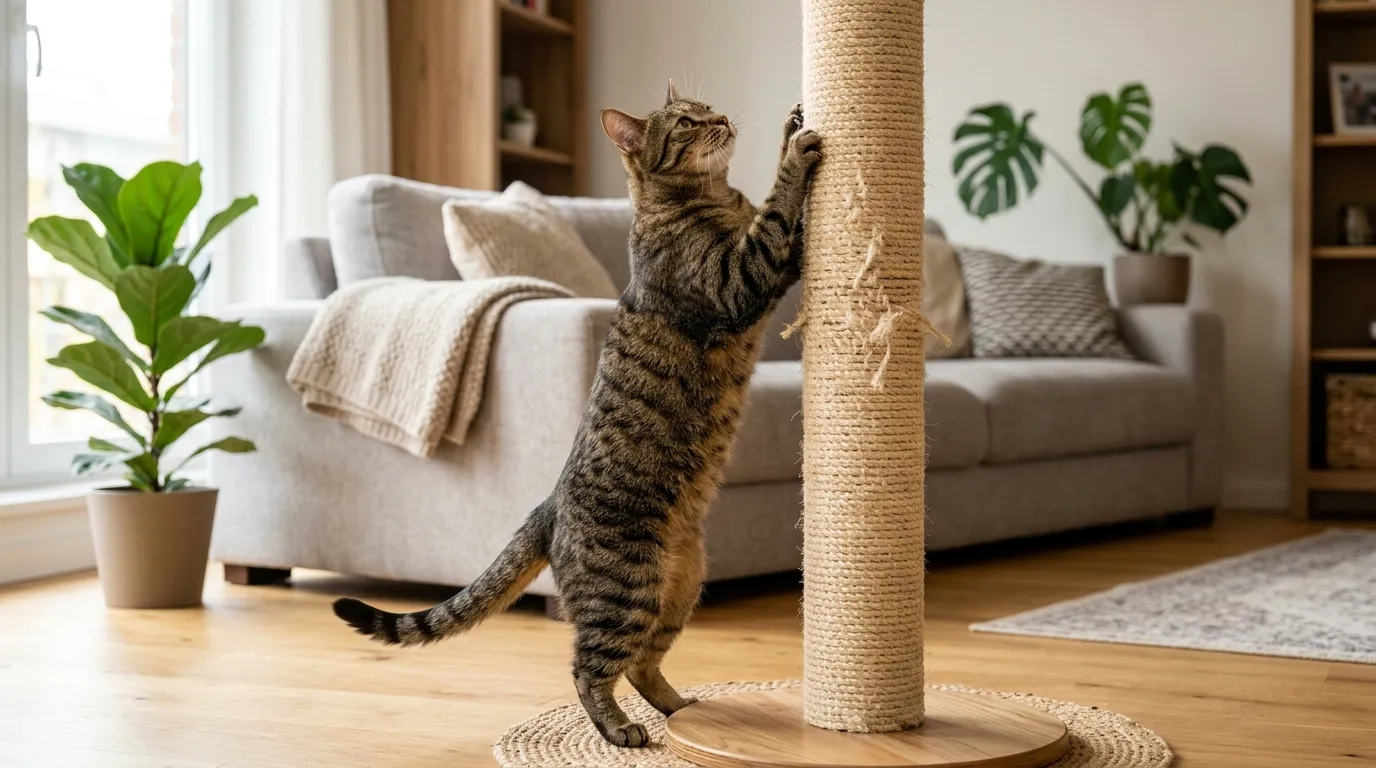
Short answer
Scratching keeps claws sharp, stretches the back and legs, and marks territory through the glands in the paw pads: it is not mischief, it is a daily need. The sofa wins because it is usually in a visible spot, stable, and has a texture that shreds in a satisfying way. A scratching post only competes if it matches those three conditions, not just because it is labelled "for cats".
The question is almost never “how do I get my cat to stop scratching”. A cat that never scratches has a problem, not a virtue. The useful question is different: how do I get it to scratch where I want, not where I don’t.
Why it actually scratches
Scratching serves three functions at once, and none of them is whim:
- Claw maintenance. It does not sharpen claws like a knife: it strips the worn outer sheath to reveal the fresh claw underneath.
- Physical stretching. Scratching upward stretches the spine, shoulders and front legs, something an indoor cat has few other ways to do.
- Territorial marking. The paw pads carry scent glands that leave a chemical signal, on top of the visible mark of the scratches. It is communication, not vandalism.
No scratching post will eliminate the need. The realistic goal is to redirect it, not suppress it.
Why the sofa wins
The furniture accidentally combines everything a good scratching post needs:
- It is where the cat spends the day, not tucked away in a hallway.
- It is stable: it does not shift or wobble when the cat pulls hard against it.
- The fabric visibly shreds, giving immediate sensory feedback to the scratch.
- It is the right height for a full stretch.
A scratching post that fails any of those four points loses to the sofa, no matter how much it cost.
What to look for in a vertical post
40 cm sisal scratching post with spinning disc toy
What to look for: A column wrapped in natural sisal, with a wide base (24 cm) so it does not tip over when the cat stretches against it, and 40 cm of height: enough for a full vertical scratch on an adult cat, though not a tall climbing post.
-
 View on AliExpress Ships internationally · checked on 2026-08-26
 -
 View on Mercado Libre Available in Chile · checked on 2026-08-27
- A wide, stable base. If the post wobbles or slides when the cat pulls hard, it gets abandoned after the first bad experience. As a rough rule, the base should be wider than the post is tall.
- Enough height for a full stretch. The cat should be able to stand on its back legs and stretch its whole body without hitting the top. A 40 cm post is enough for the scratching itself, though it will not replace a climbing tree if you are also after vertical resting space.
- A material that genuinely shreds. Natural sisal, wound in a tight spiral, gives the sensory feedback that cheap corrugated cardboard does not always match.
- Vertically wound texture, not horizontal. Sisal wrapped the right way goes with the upward stretching motion; wrapped the wrong way it feels different to the touch and the cat notices.
Where to place it
Location matters as much as the product. In order of priority:
- Right next to the piece of furniture it already scratches, not tucked into a far corner. You can move it a few centimetres a week once it is being used, but the starting point is beside the “problem”.
- Near a resting spot or a well-used path. Many cats scratch on waking up, as part of stretching.
- Never hidden away “so it’s out of sight”. A post invisible to you is just as easy for the cat to ignore.
How to redirect depending on the furniture affected
| If your situation is… | Works well | Better avoided |
|---|---|---|
| Scratches the back or arm of the sofa | Vertical post placed right at that spot, same angle | Placing it in another room hoping the cat will find it on its own |
| Scratches the rug or the base of a door | A horizontal scratcher at that exact spot, and protect the area while it adjusts | A vertical post when the cat clearly prefers a flat surface |
| Scratches on arriving home or on waking up | A post near the front door or the bed | A post far from those routines, however good the quality |
| Several cats at home | At least one post per cat, in different spots | One shared post: a dominant cat may monopolise access |
While it adjusts
- Temporarily protect the furniture with a plastic cover or a blanket that does not offer the same tactile payoff: it will not remove the temptation, but it reduces the damage while the new post earns its place.
- Reinforce with treats or catnip when you see it use the post, in the moment, not afterwards.
- Do not carry it to the post while it is scratching the sofa. Interrupt calmly, without scolding, and guide it toward the alternative.
When it isn’t just about the post
A cat that suddenly scratches much more than before, that also marks with urine, or that shows other behaviour changes may be responding to environmental stress: a move, a new cat, a change in routine. In those cases a scratching post helps, but the underlying cause needs to be addressed separately, and a sudden, marked change in behaviour is worth ruling out a medical cause for with your veterinarian first.
Frequently asked questions
Does punishing my cat for scratching the sofa work?
Not long term. Punishment teaches the cat to avoid scratching in front of you, not to stop scratching the sofa. It learns to hide, not to prefer another surface.
Vertical or horizontal scratcher?
It depends on how your cat scratches. Watch it: if it stretches upward against the sofa, it needs a vertical post. If it scratches the rug or the floor, a horizontal one. Many cats use both for different reasons.
Why does my cat ignore the new scratching post?
It is almost always location: it got placed in a low-traffic corner. The post needs to be where the cat already scratches, at least at first, even if it clashes with the decor.
Do nail caps or trimming replace the scratching post?
No. Trimming reduces the damage but does not remove the behavioural need to scratch. Nail caps prevent natural wear and not every veterinarian recommends them; check before using them.