Why your dog eats too fast, and how to actually slow it down
Emptying the bowl in seconds is not enthusiasm: it is a habit with real risks. Causes, warning signs, and how to pick a slow feeder that works.
Short answer
A dog that empties its bowl in under a minute is not "eager to eat": it is at risk of choking, vomiting, or, in deep-chested large breeds, of gastric torsion. The fix is not a smaller portion, it is changing how the food is presented: a bowl with ridges forces slower eating without changing how much the dog eats.
There is a very specific moment that triggers this question: the dog finishes eating, walks away from the bowl, and gags or vomits the food back up, almost whole, two minutes later. It is not that the bowl was “too tasty”. It is that air went down along with the food, and the stomach sends it back.
Why it happens
It is almost never enthusiasm about the flavour. The more common causes are different:
- Real or perceived competition for food. Dogs that lived in a group, were rescued, or share a home with another dog or cat that approaches the bowl learn that eating fast means eating safely.
- A habit since puppyhood. If it has always eaten alone and fast, there is no reason for that to change unless the context does.
- Genuine hunger from an insufficient portion. Before buying anything, it is worth confirming with your veterinarian that the daily ration matches the dog’s weight and age.
- General anxiety, not food-specific. In these cases a slow feeder helps with the symptom, not the cause.
The risks, in order of severity
- Gastric dilatation-volvulus (bloat). The serious one. It mostly affects deep-chested large breeds (Great Danes, German Shepherds, Boxers, among others), and eating fast followed by physical activity is one of the factors that favours it. It is a veterinary emergency.
- Choking and aspiration. Swallowing large unchewed pieces can block the airway.
- Regurgitation. The most common and least serious outcome, but unpleasant for the dog and messy to clean up daily.
- Air swallowing and bloating. Gulping air along with the food causes gas and mild abdominal distension.
What a slow feeder actually does
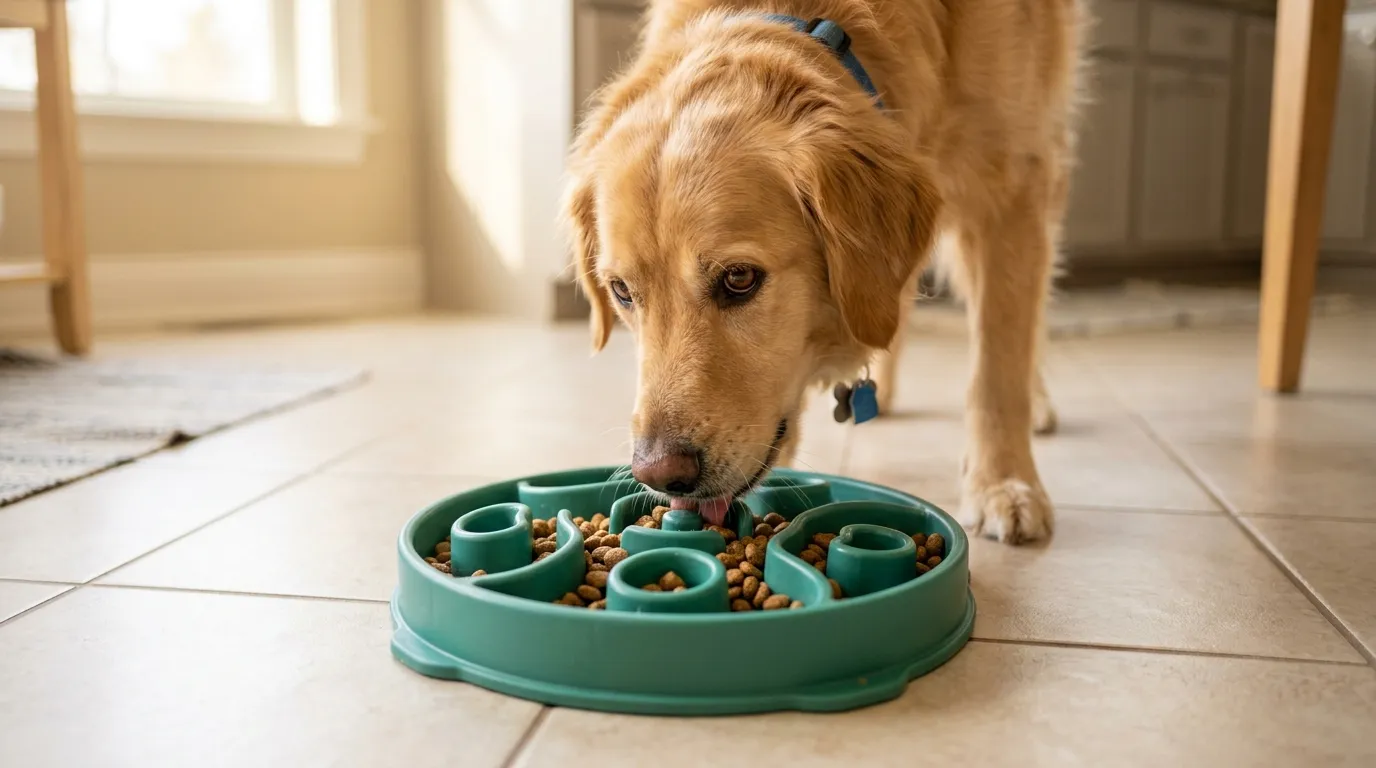
It does not reduce how much food is there: it changes how it is accessed. The raised pattern — a maze, petals, columns — forces the dog to work its tongue or muzzle around each mouthful instead of hoovering the whole bowl in one pass. The result is not that it eats less, it is that eating the same amount takes longer.
Maze-style slow feeder bowl for dogs
What to look for: Maze-shaped ridges that force the dog to work around the food instead of gulping it in one go, a non-slip base so it does not slide across the floor, and real capacity for a full portion rather than a novelty that only fits a handful of kibble.
-
 View on AliExpress Ships internationally · checked on 2026-08-26
 -
 View on Mercado Libre Available in Chile · checked on 2026-08-27
How to choose one that actually works
- Tall, narrow ridges, not decorative ones. If you can fit three fingers together into a single channel, the ridges are too wide to slow down a determined dog.
- A non-slip base. A bowl that slides across the floor as the dog pushes with its muzzle defeats the purpose and can end up tipped over.
- Real capacity for the full portion. A bowl that only fits half the meal forces a mid-meal refill, which brings the rush right back.
- Material that tolerates a dishwasher or hot water. Deep channels trap wet food residue and need a thorough wash every day, not just a rinse.
- A size that matches the dog. A small dog needs narrow channels for the effect to register; on a large dog, fine ridges empty out almost as fast as a flat plate.
Alternatives without buying anything
If you want to test the effect before deciding, or simply prefer not to buy:
- Spread the portion on the floor or on a clean baking tray, somewhere easy to clean. The dog has to hunt for each piece instead of finding it all in one spot.
- Roll the food inside a towel and let the dog unroll it. It works as enrichment and as a brake at the same time.
- Split the portion into two or three bowls placed around the room, if you have the space and no other animal is competing for them.
Signs to stop and get advice
- Frequent vomiting after eating, not occasional.
- A visibly bloated, hard-to-the-touch abdomen, or unproductive retching.
- Weight loss despite eating normally.
- The slow feeder changes nothing after two weeks of consistent use.
Frequently asked questions
How long should my dog take to eat?
There is no exact number, but as a reference: 3 to 8 minutes for a normal portion is reasonable. Under a minute is the sign worth paying attention to.
Does a slow feeder work for every dog size?
It works for all of them, but the size of the ridges matters: a small dog needs narrow channels for the effect to show, and a large dog needs a bowl with real capacity, not just patterns at the bottom.
Can I get the same effect without buying anything?
Yes. Spreading the portion on the floor, hiding it in a rolled towel, or using a clean baking tray with the food scattered across it produces a similar effect. A bowl is just easier to wash and repeat daily, not the only way to solve it.
Is eating fast the same as being hungry?
No. A dog with regular access to food and a healthy body weight that still gulps in seconds has a habit, not a shortage. Increasing the portion does not change the speed; it changes the size of the problem.